In a previous post, I argued that having values often involves finding softer monisms (as opposed to hard power such as violence or money). It is also possible to have pluralist values where there is no one determiner of power or value. Monistic values can be identified along two axes in two different ways.
On the axes below, Nexus State Theory is superficially a self-expression and freedom theory. It does not have an explicitly religious component. Moreover, it is less about benevolence and more about freedom, agency, self-determination, and autonomy. However, it could be related to religious ideas about free will. Moreover, insofar as we believe that humans are basically good, we might hold that people who attain a nexus state are more likely to be benevolent than people who lack self-control.
1. The religion axis vs. the diversity / self-expression axis.
This is the Inglehart-Welzel map: the vertical axis is the religion axis (which they call “traditional vs. secular-rational”) with religion being at the bottom. The horizontal axis is the diversity / self-expression axis (which they call “survival vs. self-expression”).
Here is a link to the most recent version::
https://www.worldvaluessurvey.org/WVSNewsShow.jsp?ID=467
Here is a Wikimedia Commons image of an older version. The more recent version shows the countries being closer to a diagonal line running from lower left to upper right (they are choosing between religious values – on the lower left – to diversity / self-expression values – on the upper right).
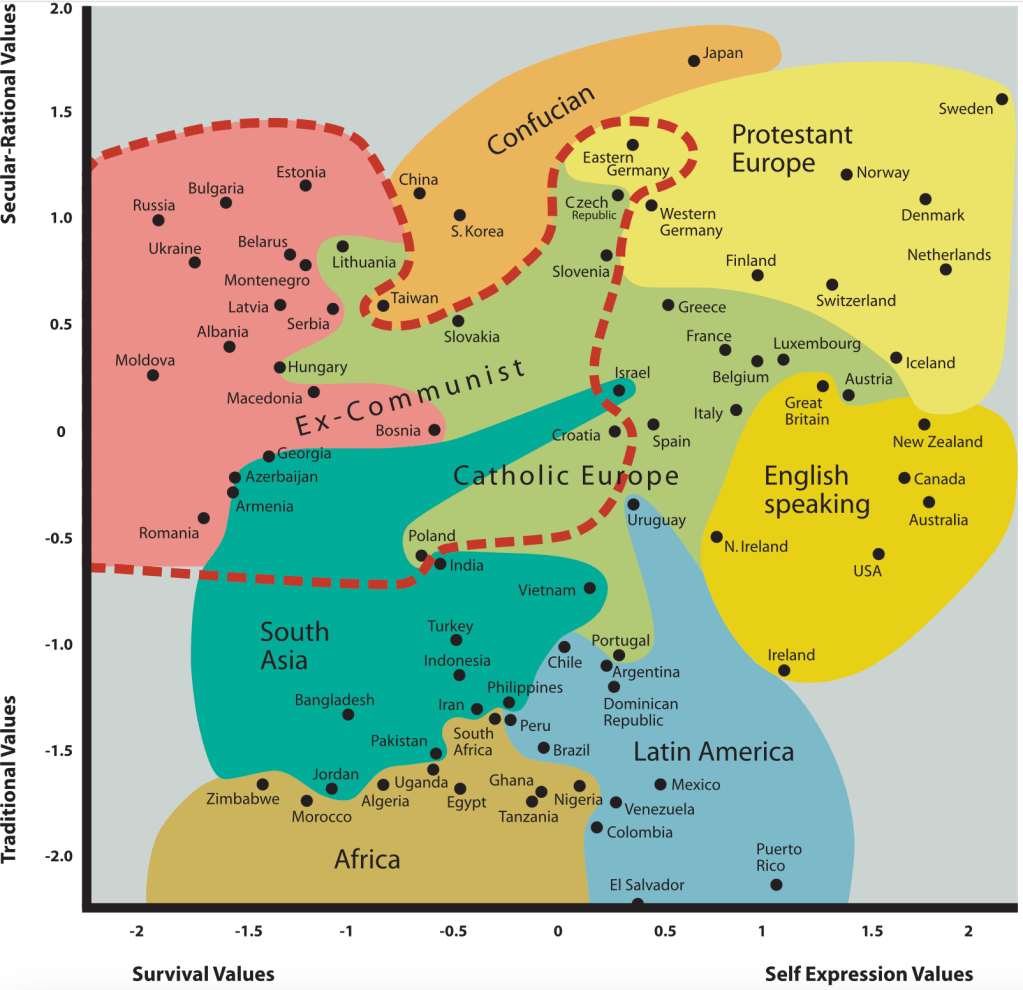
I would argue that the (monotheistic) religious values – called here “traditional values” – are a response to hierarchical power dynamics in the ancient world – the hard power of the king or state – while the diversity / self-expression values – called here just “self-expression values” – are especially a response to the hard power of the democratic majority, which is Fascism.
Essentially, traditional / religious values address the problem of the power of the “high” vs. the “low” – the king or state vs. the people. In contrast, diversity / self-expression values address the problem of the power of “in” vs. “out” – the in crowd (people of the dominant ethnicity, religion, sexuality, etc.) vs. the out crowd (people from non-dominant or marginalized groups). The former became an issue as soon as the state came into being, while the latter increasingly became a problem in democracies, where the people have more of a voice and the in crowd has a great deal of power. In either case, it is primarily the hard power of the state or in crowd that is the issue.
Inglehart and Welzel, I believe, acknowledge that self-expression values increased rapidly after World War Two; however, they attribute this increase to greater material well-being and education. In contrast, I would argue that self-expression values are a reaction to the Fascist violence / solidarity monisms that were expressed in World War Two.
2. The freedom axis vs. the benevolence axis
This is another way to look at values, in particular morality. I suggest that both religious values have a freedom component and a benevolence component.
An example of the freedom value is Exodus, in which the Jews are delivered from slavery in Egypt. These events supply the origin of three important Jewish holidays: Passover, Sukkot, and Shavuot.
An example of the benevolence value is Leviticus 19:18 (love your neighbor as yourself) and Jesus’ later emphasis on love for God and neighbor being the highest commandments. (As well as love for enemies,)
When it comes to secular values, our concern is more often the relationship between the individual and the state. There may be more of a tension between benevolence (which is often carried out by the state) vs. freedom (which frees us from the state).
Thus, in diversity / self-expression, an example of the secular freedom value is Existentialism – which began with Kierkegaard and Nietzsche and continued with Sartre and others. This value holds that we can construct our own authentic worldview. Nietzsche may have believed that state and religious control were not examples of authentic values (he says that the state is “the coldest of all cold monsters.”)
The secular freedom value was also expressed by Franklin Delano Roosevelt in his 1941 State of the Union address, although I would say that although his first two points are about freedom, the latter two (freedom from want and violence) are closer to what I would call benevolence.
“In the future days, which we seek to make secure, we look forward to a world founded upon four essential human freedoms.
The first is freedom of speech and expression–everywhere in the world.
The second is freedom of every person to worship God in his own way–everywhere in the world.
The third is freedom from want–which, translated into world terms, means economic understandings which will secure to every nation a healthy peacetime life for its inhabitants-everywhere in the world.
The fourth is freedom from fear–which, translated into world terms, means a world-wide reduction of armaments to such a point and in such a thorough fashion that no nation will be in a position to commit an act of physical aggression against any neighbor–anywhere in the world.”
Another secular example of benevolence, compatible with self-expression, is John Stuart Mill’s idea of maximum happiness. Mill believed that his ideas could be implemented by the state. Likewise, Marx’s secular ideas led to strong states which at least claimed to be benevolent. However, both Mill and Marx also highly valued freedom. By allowing for secular benevolence, we also give a voice to Plato and Confucius, who promoted their own models of a benevolent state.
Nexus State Theory, however, is less concerned with benevolence having to do with the state and more concerned with the individual experience and with dyadic relationships between pairs of humans, who (I have argued) may want to escape from their own mutual sink states. In this way, I am attributing dyadic ethics to a kind of joint freedom rather than (only) to mutual benevolence. This, as far as I know, is an unusual focus for secular philosophy to have; however, it is rooted in the ideas of Martin Buber about dyads (who in turn was informed by Jewish mysticism.)
In other words – in my view, one of the most original contributions of Nexus State Theory is the attribution of joint nexus states to dyads – hence making joint agency – and escaping joint sink states – highly valuable in the dyadic ethic.
3. Value Sort
Diversity / self-expression and freedom also lead to a perspective where one’s true values are not monistic (not just freedom and not just diversity) but are actually radically plural. Thus, although one takes advantage of freedom values to define oneself, it does not follow that one’s highest value is freedom or any other single value. One may then identify with a value sort, such as the following, where one chooses one’s most important values:
https://www.guilford.com/add/miller11_old/pers_val.pdf?t=1
This is less monistic and potentially more authentic to one’s own inner life than simply naming diversity / self-expression or freedom as the value.
 Nexus State Theory