Your complete set of interconnected (or disconnected) states is called your bodymindmap. The bodymindmap could be imagined as an enormous map that shows those states that are central to your bodymind (“nexuses”) as well as states that are more peripheral, along with states that are relatively disconnected from the rest of the map.
You can imagine arrows that point from one state to another. An arrow indicates that it’s easy to get from the former state to the latter state. The absence of an arrow indicates that it’s harder. A state with few or no outgoing arrows is a sink state. Arrows can arise for many reasons – for example:
- Habitual thinking: you’ve built a habit that links certain thoughts or emotions.
- Reasoning patterns: you typically reason in certain ways.
- Stimuli: particular stimuli commonly trigger you to switch from one state to another.
- Memory: you have a memory that commonly triggers you to make the switch.
- Stress response: switching from one state to the other is a common response to stress.
- Social influence: your friends or family commonly help you make the leap.
- Self-talk: the kinds of stories you tell yourself tend to push you from one state to the other.
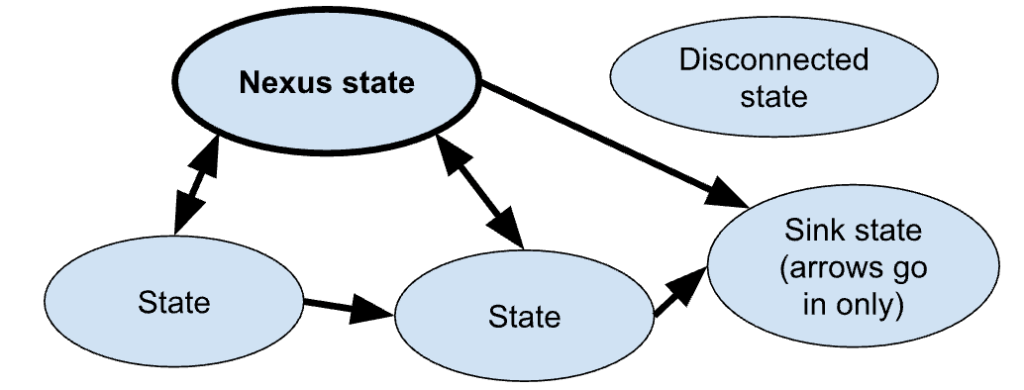
Figure 1: A nexus state has arrows going to many peripheral states
A nexus has many outgoing arrows, indicating that it is possible to get to many states from the nexus. As a general principle, your perceived ability to determine your own state (“self control”) is enhanced when your state is at a nexus and reduced when your state is disconnected or is a sink. That’s because a nexus state involves a state of confidence that effort will be rewarded. To develop this confidence, it helps to actually reward oneself with DHR states, which are likely to promote net positive pleasure – pleasure which is generally free of guilt and other aspects that detract from enjoyment. I will cite some sources about self-regulation and: being in a natural setting [1], exercise [2], autonomy [3], meaningful work [4], music [5, 6], and art [7]. All of these are examples of DHR states that I would expect to be associated with self-control.
However, the notion of “self control” is itself an ambiguous idea. That is, you are always doing something; but in what state are you “in control” of yourself? This metaphor (the self controlling the self) is just a metaphor; there isn’t really a whole self inside the self controlling it (who is controlling the inner self?) Therefore, as usual, the true judgment belongs to the reader and not to these studies. When you do these activities, do you feel more in control? You might want to try it and find out!
One definition is that self control is simply the experience of being in a state with many outgoing arrows. A nexus state might be entered deliberately, but it could also be triggered by the environment. Perhaps you tend to enter a nexus state in certain locations, on certain days of the week, or at a certain time of day.
Most states are somewhere in between a nexus state and a sink state. You can imagine a spectrum of states. At one end are the nexus states, with arrows going out to all manner of other states. In a nexus state, you can get yourself to do all manner of onerous tasks. At the other extreme are the sink states, which are easy to get stuck in. However, there are many other states in between. Perhaps when you have less energy, you’re in a state that has some outgoing arrows, but only to tasks that require little energy.
Vocabulary
- Bodymindmap: a map of states connected by arrows, showing which states can be reached from which other states.
- Nexus state: a state in which one has the maximum self control or agency. This is a state in which one expects effort to be rewarded by net positive pleasure.
- Arrow: a symbol in a bodymindmap diagram indicating that one state can lead to another. The word “arrow” can also refer to such a connection even outside the context of a diagram.
- Sink state: a state which can reach few or no other states.
- Disconnected state: a state which can reach and be reached by few or no other states.
[1] Beute and Kort, “Natural resistance: Exposure to nature and self-regulation, mood, and physiology after ego-depletion,” Journal of Environmental Physiology (2014).
[2] Boat and Cooper, “Self-Control and Exercise: A Review of the Bi-Directional Relationship,” Brain Plasticity (2019).
[3] Muraven, “Autonomous Self-Control is Less Depleting,” Journal of Research in Personality (2008).
[4] Copeland, Jones, and Field, “The association between meaning in life and harmful drinking is mediated by individual differences in self-control and alcohol value,” Addictive Behaviors Report (2020).
[5] Baltazar and Suvi Saarikallio., “Toward a better understanding and conceptualization of affect self-regulation through music: A critical, integrative literature review,” Psychology of Music (2016).
[6] Williams, “Moving to the Beat: Using Music, Rhythm, and Movement to Enhance Self-Regulation in Early Childhood Classrooms,” International Journal of Early Childhood (2018).
[7] Baum, Owen, and Oreck, “Transferring Individual Self-Regulation Processes from Art to Academics,” Arts Education Policy Review (1997).
 Nexus State Theory