Our current psychological environment is very different from the hunter gatherers’ mental landscape. We think we can know and control everything. We are more likely to have difficult-to-manage unpleasant emotions that we think we can’t share with others, to live in our head instead of our body, to live in the future instead of the present (in order to manage our money, for instance), to use reason to ruminate about negative consequences instead of to rethink problems, and to spend time in cities rather than in nature.
In Part Three, we are going to consider techniques for getting into a “hunter gatherer head space” – an Intrapersonal Default Human Range state. This will help us become optimists by teaching us that effort leads to net positive pleasure. A state is intrapersonal (as opposed to interpersonal) if it can be entered without depending too much on other people or on wealth. Thus, a state that is about possessing a fancy house requires us to own such a house. And a state that is about belonging to an exclusive club requires us to belong to that club. Whereas a state that is about appreciating art just requires going to the local art museum (assuming that is free or cheap) or owning a painting (assuming that is not too expensive.)
The hunter gatherer headspace is not mutually exclusive with more material solutions for changing society. Indeed, entering a nexus state via our headspace may motivate us to believe that social change is possible. However, at moments when we are frustrated with material circumstances, it could be helpful to focus on our headspace.
As usual, we want to build arrows to a nexus state. The goal is still to get out of a sink state, which limits agency, and get into a nexus state, which expands agency.
I will name a variety of intrapersonal arrows to nexus states for this purpose:
Being present
These arrows involve noticing one’s breath, body, or surroundings.
- A Present Moment arrow
- An Awareness of Body arrow
Reading
These arrows involve learning or reading something.
- A Literary arrow (reading fiction)
- A Learning arrow (reading nonfiction)
Activities
These arrows involve doing something enjoyable.
- Listening to music.
- Going for a walk in nature; going somewhere.
- Doing physical exercise.
Narratives
These intrapersonal arrows involving telling a story about oneself. It is enjoyable to find meaning in such a narrative.
- An Awareness of Emotion arrow (a narrative about our emotions)
- A Serenity arrow (a narrative about what we can and cannot control)
- A Mystery arrow (a narrative about what we can and cannot know)
- A Secure Base arrow (a narrative about supporting oneself emotionally)
- A Cognitive Behavioral Therapy arrow (reasoning about one’s problems)
- A Positive Self-Talk Arrow (talking to oneself in a positive way)
Compassion
When compassion or giving is unilateral, expecting nothing in return (not even praise), it can be intrapersonal in a sense. One is not negotiating a shared project with the other person (which would be dyadic) but rather helping them in some concrete way. Learning about compassion requires trusting the motives of others – knowing that their actions are selfless, rather than being motivated by status and dominance. This trust is, at some point, partly a choice: we can choose how to construe other’s motives.
This might be called BRANCH theory: Being Present, Reading, Activities, Narratives, and Compassion lead to intrapersonal Happiness.
When I mention each arrow, I will say whether it is a narrative, reading, activity, being present, or compassion arrow.
None of these arrows are a “quick fix.” As with breath meditation, one may have to access a given pleasurable state repeatedly in order to build the arrow to the nexus state. In this case, the state of mindfulness on the breath is not inherently a nexus state; rather, this mindful state is a state which eventually teaches us that effort leads to net positive pleasure. When this lesson is learned in a deep way, we can enter a nexus state.
Although there are times when a Default Human Range (DHR) state helps immediately, as when listening to music can immediately bestow self-regulation abilities, at other times the DHR state is more of a long term aid. Also as with breath meditation, it is not necessary to try to access the DHR state only when one is stuck in a sink state. One can also access it every day at a certain time, for example. This kind of practice will eventually help us to access the nexus state when we are stuck.
The Awareness of Emotion arrow was the focus of James’ story about losing the book. After losing the book, James felt sad. But then, he reframed (renarrativized) his interpretation of events. Instead of the loss of the book being the central event, his sadness itself became central. This helped James to enter an Intrapersonal Default Human Range state. In this case, it’s less that I think hunter gatherers frequently analyzed their emotions, and more that they had positive explanations or stories for things. An emotional story is such a story.
“[James] realized his sadness didn’t have to be “solved” by finding the book. Sadness was something he had experienced many times before in his life. Each time he had been sad, the sadness had always changed, eventually. Sadness was transient. I feel terrible that I lost my book because I am sad. This new awareness opened a door in his mind.”
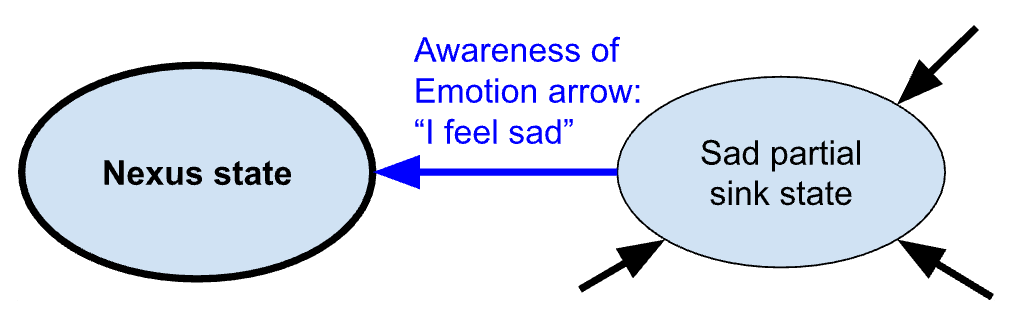
Figure 4: An Awareness of Emotion arrow exits a partial sink state.
The Awareness of Emotion narrative is a kind of Intrapersonal Default Human Range state – in particular, it is a Narrative Arrow. The narrative may include:
- Its okay to feel this emotion.
- This emotion is transient; everything changes
- I can seek help from others to deal with this emotion.
- I can write about these emotions to help myself understand them. better.
- Emotions sometimes helpfully point to ways we can reframe the thoughts that are associated with those emotions.
These are DHR states in the sense that helpful narratives are DHR – because helpful self-discourse inherits its positive nature from helpful discourse with others.
It is important to allow the Awareness of Emotion arrow to access whatever tool or response to the emotion we may need – which may include solving a problem, seeking support from others, accepting the emotion, or just feeling the emotion. By allowing many possible solutions, we increase the likelihood that the outcome will give us net positive pleasure.
There is no universal correct reaction to an emotion; it depends on the circumstance. In fact, putting too much pressure on one single approach can be a source of increased stress. If James believes that the only way to deal with sadness is to locate his book, then he may feel even worse if he does not find it.
Valence vs. arousal
In order to discuss or think about an emotion, it may be helpful to note one’s emotion on axes of valence (positive or negative) and arousal (high arousal, low arousal). These axes are mentioned in the book Affect Regulation Theory by Daniel Hill. Some examples might include:
- Positive and high arousal: joy, excited
- Positive and low arousal: calm, contented
- Negative and high arousal: anger, anxiety
- Negative and low arousal: sad, apathetic
Name emotions, not verbs
I believe it is helpful to name emotions, not verbs. We often name verbs so that our “feeling” works as a kind of accusation. Thus, we say “I feel attacked” to mean “you have attacked me” or “I feel hurt” to mean “you have hurt me.” I suppose there could be situations where the best possible renarrativizing is accusatory in this way. However, more frequently, it is better to name a genuine emotion such as sadness, fear, anxiety, excitement, anger, and so on rather than naming a verb. If you are not sure whether a given emotion word is a real emotion, find a list of emotions online and try to choose a word from the list.
Suffering
A Suffering arrow is akin to the Awareness of Emotion arrow for negative valence. Here, we simply recognize that we are suffering, and (as with Buddhism’s observation) the suffering is transient. All things change. The Suffering arrow may be helpful if we are unable to name the emotion we are experiencing, yet we are able to say that it is unpleasant (has negative valence.)
The Awareness of Emotion arrow, as with all therapeutic arrows, helps us both in the short run and the long run. In the short run, it can sometimes get us into a nexus state immediately. However, in the long run, it can build persistent arrows from a sink state into a nexus state, giving us more agency. In either case, it a achieves this by helping us to experience a net positive pleasure in our awareness of and response to our emotions.
Awareness of Desire and McClelland’s theory
Desire is a little bit like an emotion; it is more precisely a motivational state. However, Awareness of Desire can be helpful in the same way as Awareness of Emotion. McClelland classifies three human needs (desires or motivations):
- Power – controlling oneself and others
- Affiliation – friendship, family, and other connections
- Achievement – accomplishments of all kinds
These desires can be sink states; this becomes more likely if they are directed at Learned Layer (LL) phenomena such as money or hierarchical status (although, as mentioned previously, most people enjoy at least some LL states), or if they are a reaction to Default Human Range of Stressors (DHRS) situations that would have been dangerous for hunter gatherers, such as loneliness. Awareness of emotion enables us to let go of them. It is helpful to be aware of which desires are most important to you, and to think about when you would like to let go of them.
Vocabulary
- Intrapersonal Default Human Range: A Default Human Range state that does not depend too much on other humans or on having substantial wealth.
 Nexus State Theory