If an open state represents an emotionally difficult event rather than an unfinished task, it may be harder to close the state. An open sink state is an open state that is difficult to close. It is difficult to close because it has few or no outgoing arrows. The reason may be that the sink state possesses a limiting narrative – a set of thoughts and emotions that are “sticky” or hard to get away from. This sticky narrative suggests that effort to leave the state will not be rewarded, which limits the kinds of states that can follow the sink state.
Sticky narratives are often learned by experiencing DHRS states (Default Human Range of Stressors). Thus, whereas hunter gatherers usually lived in groups of twenty people or more, modern humans often have only a small number of close friends and family. For this reason, modern humans may have the experience that feelings of loneliness are hard to escape. This means that we are more prone to experiencing sink states and sticky narratives around the issue of rejection or loneliness. The modern degree of loneliness is outside the Default Human Range (DHR), relatively speaking.
An open sink state can be a task state, a trauma state, or any other state. The goal is not only to close the state – which is a short term goal – but to build outgoing arrows in the long term. These outgoing arrows help you to release the limiting narrative – not only this time, but next time this state recurs. The outgoing arrow represents a belief that effort can matter.
There can also be closed source states that are hard to open because they only have outgoing arrows.
When state A has no arrow going to state B, it is hard to do any of the following:
(1) Get from A to B.
(2) Open B while in state A.
(3) Close A while in state B.
(4) Maintain a shared understanding of the two states at a single time.
(5) Think or talk about one from the vantage point of the other.
(6) Tolerate ambiguity or uncertainty between the states.
(7) Maintain a balance between the two states.
A partial sink state may have “weak” outgoing arrows – it is a sink state, but one that you can escape with effort. For example, the internet, which is in the Learned Layers (LL) rather than DHR, is a common source of sink states. It may be that if you’ve surfed the internet for an hour, it’s too late – you can’t escape this true sink state – perhaps for many more hours. But if you just think of the internet during meditation, you can escape the thought and return to meditating. Therefore, the mere thought of the internet is a partial sink state.
Likewise, a transition state between activities may be a partial sink state. It may be easier to escape the transition state than the activity itself.
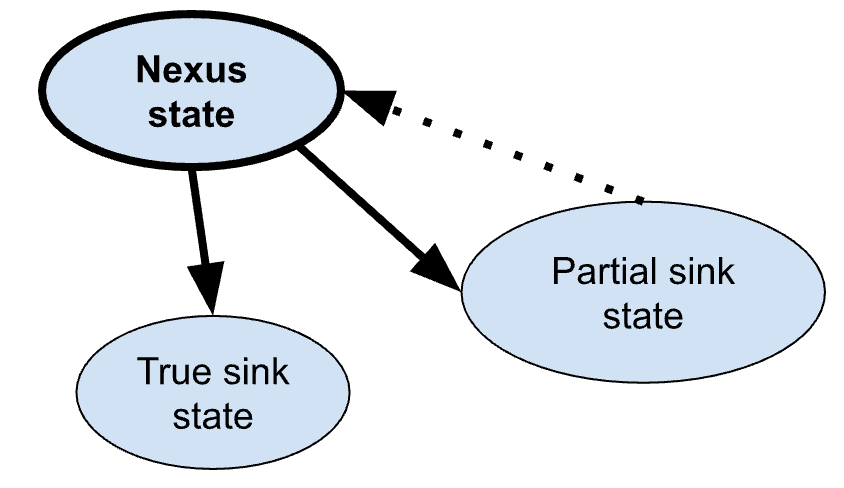
Figure 2: Having surfed the internet for an hour, your state may behave as a true sink state – one that you cannot escape until it “decides” to let go of you. However, merely thinking of the the internet during meditation may act as a partial sink state – one that you can escape with effort. In fact, in this case, learning to escape the partial sink state may help you to later escape the true sink state.
Some traits that make make a sink state more “partial” as opposed to a “true sink state” might include:
- A therapist is present to help you transition out of the partial sink state. Communicating with other humans is in the DHR.
- The partial sink state only imagines a sink (say, something scary or angering) as opposed to really being that sink itself.
- You are in between activities.
- The partial sink state is a sink state that you’ve practiced getting out of in the past.
- The partial sink state contains some other DHR traits, such as music or natural scenery.
- You manage to denarrativize or renarrativize the sink state.
Different people may experience these aspects of sink states differently. A state that is a true sink state at one point in your life may become a partial sink state later.
Disconnected states and sink states can also lead to all or nothing thinking, meaning that you are either in one state or another; you cannot imagine any hybrid state, and you cannot accept a degree of uncertainty about which state you should be in.
Vocabulary
- open sink state: A state that you’re currently thinking about, and which is hard to escape.
- trauma state: A sink state that is hard to escape because it involves memories of trauma.
- closed source state: A state that’s hard to enter because there are few or no arrows pointing to it.
- partial sink state: A sink state that you can escape with effort.
- true sink state: A sink state that you cannot escape at this time.
- all-or-nothing thinking: Imagining that it’s either one alternative or the other – nothing in between.
 Nexus State Theory