Story
Jared’s heart raced as he navigated the winding hallways of his school. Today was test day, and the usual entrance to the math room was blocked for maintenance. Instead, he took a side door that led him into a labyrinth of art supplies and music rooms.
He glanced at his watch, and panic threatened. He pushed forward, reluctantly trusting his instincts. Just when he thought he might have to retrace his steps, he spotted Room 216, the math room. Relief washed over him as he took his seat.
As the test began, a different knot of anxiety twisted in his stomach. He stared at the first question, a polynomial he had never encountered before: x2−4x+4=0. He cast about wildly for a solution, and then closed his eyes, recalling the lessons he’d studied.
At once, he remembered the technique: factoring. The expression reminded him of a perfect square. Scribbling down (x−2)(x−2)=0, he realized both solutions led to the same answer. He wrote down “x=2” with a surge of confidence.
As he submitted his test, a smile crept onto his face. Somehow, despite the detour and the anxiety, he had found his way—not just to the room, but to a solution.
Analysis
Reminder: we’ve said that “state” can have three meanings:
- A momentary experience in the brain.
- A recording of such a momentary experience that persists in the brain, which can be accessed to recreate such an experience.
- A partial recording; several states together make up a recording of the brain’s experience, and several states are needed in order to recreate an experience.
State diagrams, with bubbles and arrows, can have ambiguous meaning in terms of these definitions. This meaning is up to the reader to interpret.
In Jared’s case, we can see that the brain doesn’t simply recreate a state from its memory. When Jared solves the algebra problem, his brain doesn’t “remember” a state where he’s solved this particular problem. Instead, he creates the solution on the spot. This state may activate both Default Human Range (DHR) features (reasoning) and Learned Layer (LL) features (mathematics).
Likewise, when Jared navigates to the classroom from an unusual entrance, his brain constructs the path based on partial information.
Jared can find his way through mazes of hallways that he has never navigated before and solve math problems that he has never solved before.
Here is a possible state diagram for the situation:
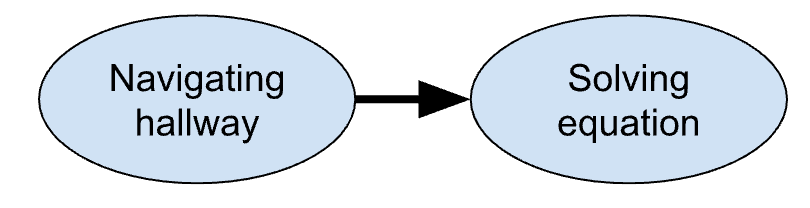
Figure 3: State diagram for Jared’s situation.
States are complicated, and the meaning of a state diagram is ambiguous and reader-interpreted. Does the bubble on the right mean a recorded state (how to solve quadratic equations) or does it mean Jared’s momentary experience, which he constructs on the spot (how to solve this particular quadratic equation)? Is the text anxiety part of the bubble on the right, or is it omitted from the diagram? We can interpret the diagram in different ways. The state diagrams are a model – a way of thinking about something complex in a simple way – but they do not have a single, specific meaning. They require our active interpretation.
Vocabulary
- Model: Thinking of something complex in a simple way.
 Nexus State Theory